


The Body of This Death
The Body of This Death
Letters from the Last Archbishop of Lancaster
Couldn't load pickup availability
Set against the backdrop of a dystopian, techno-driven future, The Body of This Death: Letters from the Last Archbishop of Lancaster follows the life of an archbishop as he awaits his execution.
Uniquely structured as a collection of letters, this fictional work leads the reader in discerning the general contours of the events that took place over the last several years of the Archbishop’s life, including his imprisonment, trial, and eventual sentence.
The Archbishop’s correspondence, including his so-called “posthumous” letters, presents his meditations on embodiment, death, and the nature of reality. The Body of This Death invites the reader to enter the labyrinth of the Archbishop’s thoughts as he anticipates his ever-approaching martyrdom.
Details
Details
Shipping & Returns
Shipping & Returns
When will my order ship?
- When items are in-stock, orders placed before 8am CT should ship out that same business day from our Illinois warehouse.
- Depending on your shipping address and the shipping method you select at checkout, in-stock items should arrive between 7-10 business days.
- If your order contains a preordered/backordered item, no items in your order will ship until the preordered item becomes available (i.e. your order will ship all at once.)
Do you ship internationally?
- We offer two international shipping methods, Passport and DHL. Passport has all taxes and duties included in the shipping cost. DHL is delivered duties unpaid, and you may be responsible for taxes and duties when your package is delivered.
- International orders are subject to unpredictable delays by customs, and are subject to security mandates, duties, and other fees upon receipt.
- Please allow international orders a significant amount of flexibility in timeframe to receipt.
- We do accept international returns, but we are unable to generate return labels for international shipments.
Can I make changes or corrections to my order?
- Please contact us as soon as possible—ideally within 2 hours of placing your order—at 866-928-1237 or sales@wordonfire.org with your order correction details. We’ll work quickly to see if any edits to your order are still possible.
- Once an order has shipped, we are unable to cancel it.
Return Policy
For non-damaged, standard returns:
Our products may be returned if they were purchased within the last 90 days, are unused, and are still in their original packaging. Original shipping costs are already collected by the shipper, and therefore the original shipping costs are not refundable.
We will provide a pre-paid return label to you. The maximum shipping cost covered will be $20. If the return shipping costs in excess of $20 to ship it to us, that will be deducted from the refund amount. (Meaning, if one orders 30 bibles and changes their mind after receiving them, it would not be good stewarding of our donor-provided funds for the ministry to cover that return shipment.)
Exceptions and limitations:
- Bulk books (evangelization pricing): Books sold in pre-boxed quantities are evangelistic in nature and priced as low as possible, and we cover the original shipping cost. For that reason, we are unable to cover return shipping costs for bulk books. If you choose to return a bulk book, return shipping will be the customer’s responsibility in that case.
- Seasonal titles (including Advent and Lenten Gospel Reflections): Seasonal titles are final sale and are not eligible for returns or refunds.
For damaged items:
For damages to the item that are significant in nature, such as missing pages, large gashes in the cover, major creases in the cover, or dents, etc, please email us at sales@wordonfire.org for a no-cost replacement. For minor damages, like a nick or otherwise tiny blemish, or a slightly bent inward corner, or a slightly flaked embossing, these returns may be accepted but the return shipping will not be covered in order to be good stewards of the donor provided funds that make our non-profit ministry possible. For items that are shipped in protective packaging, such as the Leather Bible, note that the outer box is meant to absorb damage in shipping, and the box should not be considered the product itself, and the box is not replaceable.
How can I set up my return?
Please email us to set up your return at sales@wordonfire.org.
Your order record will be retrieved by the system based on the email address you used to make the purchase. For this reason, please have the email address or the order number (example: Q######) handy when beginning the return process. We are able to accept international returns, but we are unable to generate return shipping labels from countries outside the United States.
Share
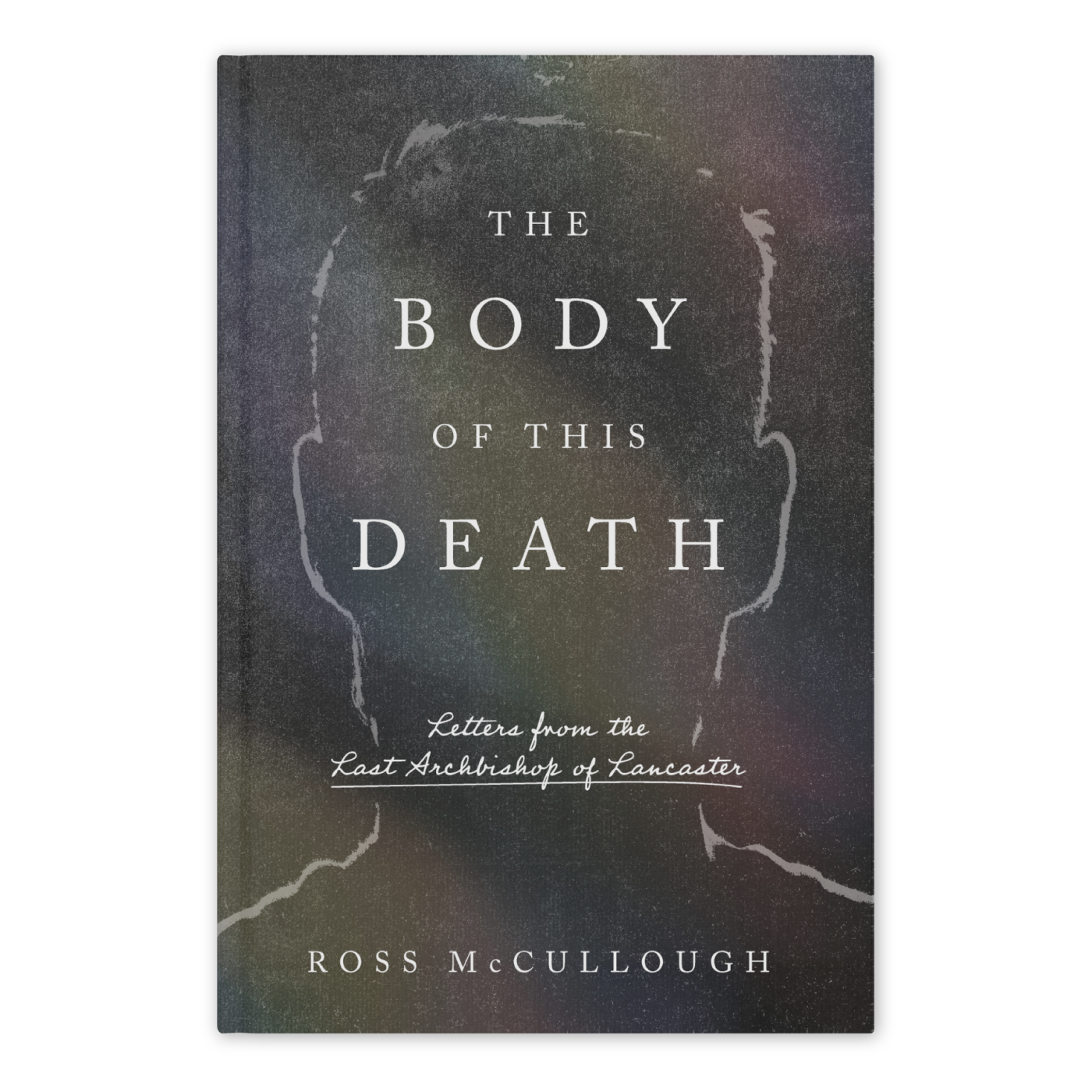

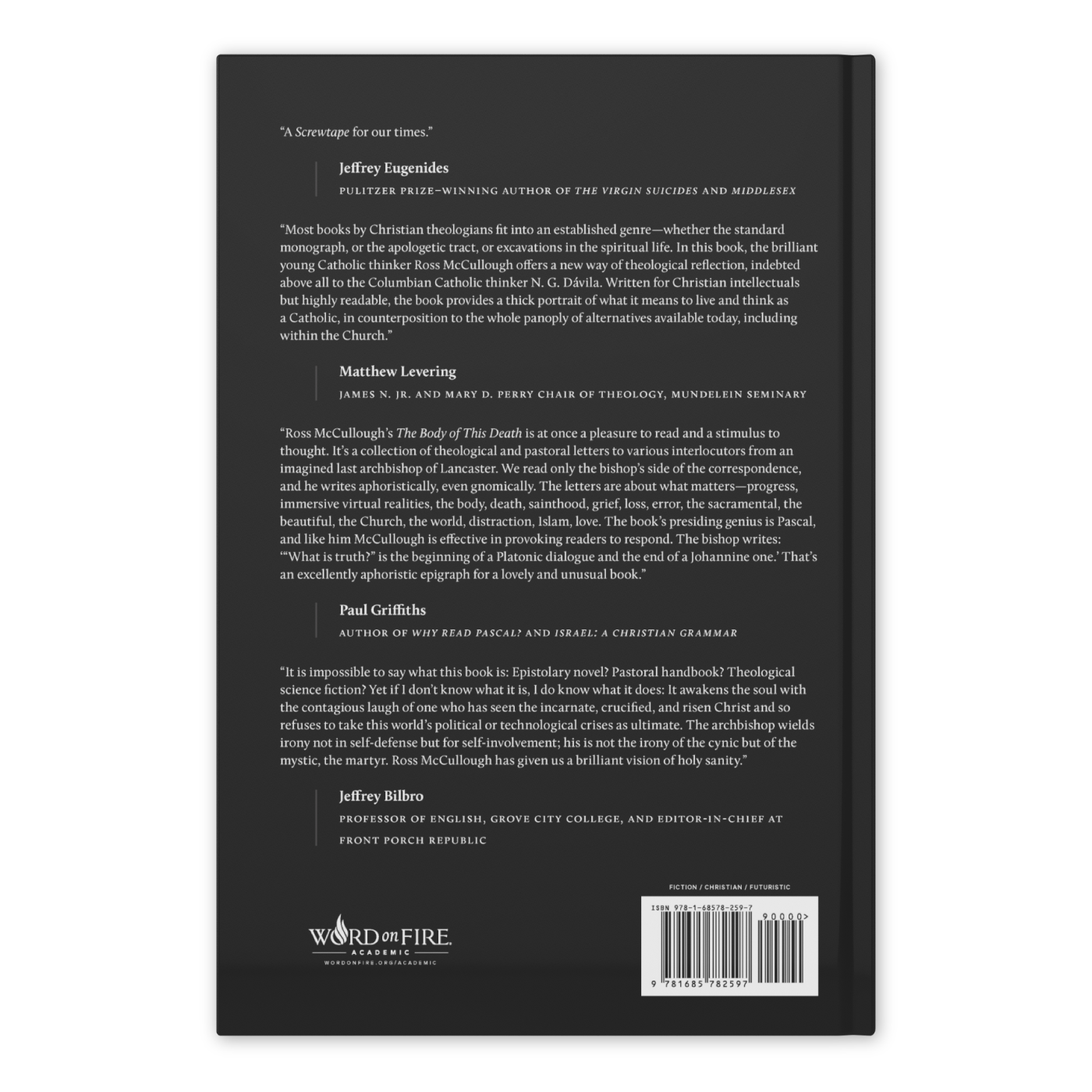
Table of Contents

What People Are Saying

“Ross McCullough's The Body of This Death is at once a pleasure to read and a stimulus to thought. It's a collection of theological and pastoral letters to various interlocutors from an imagined last Archbishop of Lancaster at some time in the near future. We read only the bishop's side of the correspondence, and he writes aphoristically, even gnomically. Much is therefore left open and underdetermined: the bishop is himself unreliable, sometimes wrong, aware of his own fallibility; but the letters are about what matters—progress, immersive virtual realities, the body, death, sainthood, grief, loss, error, the sacramental, the beautiful, the Church, the world, distraction, Islam, love—and so in reading them with attention we're moved toward engagement with these topics in their depth and complexity. The book's presiding genius is Pascal, and like him McCullough is effective in provoking readers to respond. The book refuses closure, and toward its end McCullough's bishop writes: ‘“What is truth?”’ is the beginning of a Platonic dialogue and the end of a Johannine one.” That's an excellently aphoristic epigraph for a lovely and unusual book, which I'm grateful to have read.”
—Paul J. Griffiths, Author of Why Read Pascal? and Israel: A Christian Grammar

“A Screwtape for our times.”
—Jeffrey Eugenides, Pulitzer Prize-winning author of The Virgin Suicides and Middlesex

“Most books by Christian theologians fit into an established genre—whether the standard monograph, or the apologetic tract, or excavations in the spiritual life. In this book, the brilliant young Catholic thinker Ross McCullough offers a new way of theological reflection, indebted above all to the Columbian Catholic thinker N. G. Davila. Written for Christian intellectuals but highly readable, the book provides a thick portrait of what it means to live and think as a Catholic, in counterposition to the whole panoply of alternatives available today, including within the Church.”
—Matthew Levering, James N. Jr. and Mary D. Perry Chair of Theology, Mundelein Seminary

“It is impossible to say what this book is: Epistolary novel? Pastoral handbook? Theological science fiction? Yet if I don’t know what it is, I do know what it does: It awakens the soul with the contagious laugh of one who has seen the incarnate, crucified, and risen Christ and so refuses to take this world’s political or technological crises as ultimate. The Archbishop wields irony not in self-defense but for self-involvement; his is not the irony of the cynic but of the mystic, the martyr. Ross McCullough has given us a brilliant vision of holy sanity.”
—Jeffrey Bilbro, Professor of English, Grove City College, and editor-in-chief at Front Porch Republic